
By Nick Landekic, contributing writer
Now is the time to take precautions to stay healthy
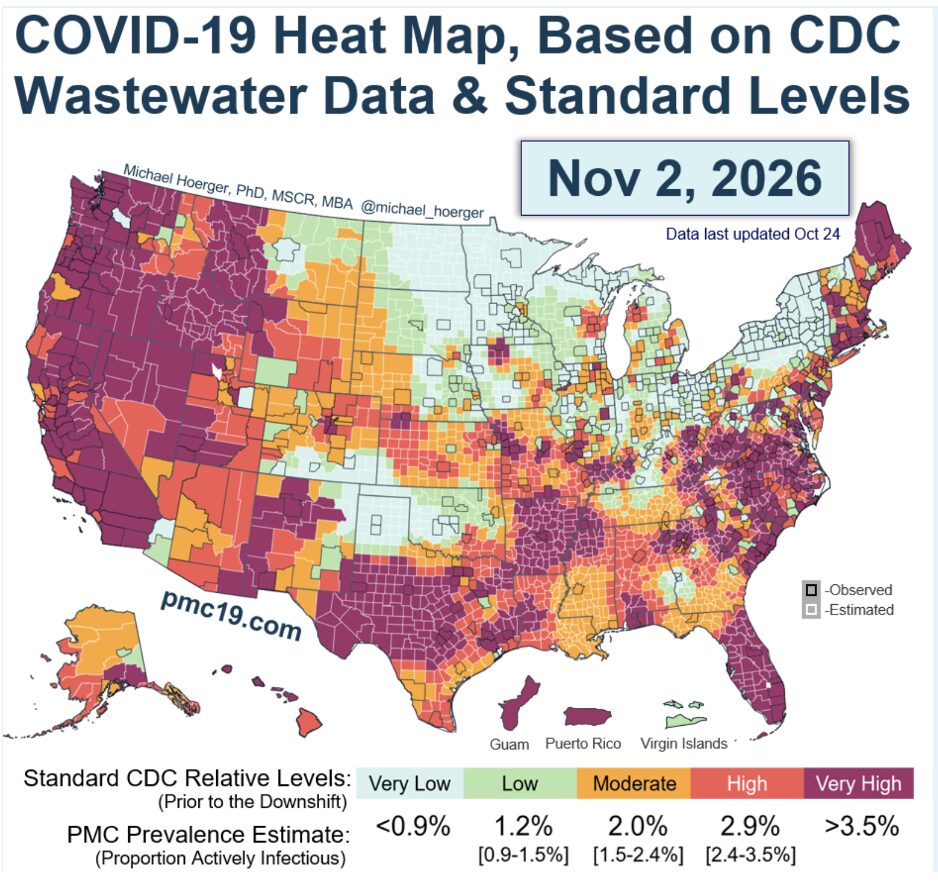
As much as we would all like to forget about COVID, it’s still very much with us and will be for a long time. Right now we are experiencing an atypical COVID surge with outbreaks reported in 47 states. COVID levels (as measured by wastewater monitoring) are Very High in Rhode Island with several areas reporting the highest levels seen all year, including Jamestown and the East Bay communities of Bristol, Warren, and Newport.
The rate of COVID infections right now is higher than it was than at any time during the first two years of the pandemic. Over 1 million people are becoming infected with COVID every day, and increasing. The Pandemic Mitigation Collaborative estimates that between 1,900 and 3,300 Americans are dying of COVID every week.
Flu has also come early this year. Every part of the U.S. is showing high flu test positivity which means we are in ‘flu season.’ Flu rates are climbing in almost every state including Rhode Island.

If you haven’t yet gotten COVID and flu vaccine shots, now would be a good time to talk with your doctor or pharmacist.
How serious are COVID and the flu?
COVID and influenza are the only infectious diseases that regularly kill tens of thousands of Americans each year. They are both serious infectious diseases. The severity of infection can be reduced by vaccination.
For both flu and COVID, the most vulnerable people are the very young and the very old. COVID is especially dangerous for seniors, while the flu is more dangerous for infants.
One of the most damaging myths is that COVID has somehow become ‘milder.’ It has not. If anything some studies have shown it has become worse. It most definitely is not like a cold or even the flu. It’s much more serious.
Repeat COVID infections take an increasing toll on the body. Studies have shown repeat infections have 2 to 3 times the risk of a worse outcome, organ, tissue, and system damage, than the previous infection.
Even if you are lucky enough to have had a relatively mild acute course of infection you can still develop Long COVID. Studies have shown that most Long COVID cases started with initially mild infections. It’s estimated that right now between 389,000 to 1,560,000 people are getting Long COVID every week.
COVID isn’t something your body can handle getting over and over again. Ask someone with Long COVID what it’s like.
What’s happening in Rhode Island?
The Pandemic Mitigation Collaborative rates Rhode Island, as well as neighboring Massachusetts and Connecticut, as currently having Very High levels of infection. 26 states currently are at High or Very High levels. They also estimate that 1 out of every 24 people in Rhode Island are actively infectious with COVID. This also means if you are in a room with 10 people, there is a 34% chance someone has COVID – and could infect everyone else in the room.

The Rhode Island Department of Health also rates our current wastewater viral activity level as High.
What about this year’s COVID vaccine?
The good news is a few months ago a total of four updated COVID vaccines were approved by the FDA. All of them target the XFG variant that is currently the predominant form of virus circulating.
In the past, the COVID virus has evolved so fast that by the time a new vaccine is available, it’s a less good match. That’s not the case right now. There have not been any new mutations to the viruses observed beyond what the current vaccines are designed to target. Thus, the vaccines are expected to give good protection. The more people who get them, the more likely it is that more people stay safe and healthy through the winter.
In the spring scientists selected three flu strains that we were likeliest to encounter later in the year and based the new vaccine on those. Two of the three strains look like a good match. It is important to remember that even when flu vaccines don’t protect against all infections, they can still do a good job at helping prevent people from becoming seriously ill. This is what vaccines are intended to do: not to absolutely prevent getting infected, but to make milder what could otherwise be a serious or even fatal infection.
There are many forms of flu vaccine available in the U.S., including enhanced high-dose formulations for people over 65 (Fluzone High-Dose, and Fluad), a nasal spray vaccine for those between 2-49 (FluMist), and mFlusiva mRNA vaccine. Talk with your pharmacist or doctor about which one may be best for you and your family.
A major development this year is the first-ever mRNA vaccine for the flu, mFlusiva. mRNA vaccines are faster and easier to produce at large scale, meaning if the flu virus suddenly mutated, we’re better positioned to quickly create a new specialized vaccine for it. The main current method of creating the flu vaccine is a six-month process that can lead to poor matches come flu season – it doesn’t allow for that level of fast responsiveness.
There is also some evidence showing that for patients 50 and older, the mFlusiva vaccine is more effective than the standard flu vaccine.
Talk with your doctor or pharmacist to find out which option might be best for you.
Why did these infection surges come early this year?
Usually flu season starts in the south, especially in Florida, and works its way north. This year things are different: the hot spot is the Northwest – our area.
According to Maya Brownstein at the Harvard School of Public Health, this is probably in large part due to the evolution of the H1N1 flu virus, which also caused an unusually early flu season in Japan. In the time since this year’s flu strains were selected to create the vaccine, the H1N1 virus picked up a mutation allowing it to evade existing immunity in some people – especially children and adolescents. This may be because children have only ever been exposed to the strain of H1N1 that caused the 2009 flu pandemic and its descendants, while older people have immunity against a wider diversity of H1N1 strains.
As a result, younger people, especially school-age children – a group known to be major vectors of flu transmission – will likely have a higher chance than usual of being exposed and infected. That could be a driving force in the early spread of flu and could very well continue being an important factor in how this year’s flu season unfolds.
COVID has been surging across Europe for the past couple of months. Infection rates across Europe are even higher than in the U.S. Some countries are closing schools, cancelling surgeries, shutting bars and restaurants, and imposing curfews as hospitals and doctor’s offices are overwhelmed with infected, sick patients.
The viral variant sweeping across Europe is the same XFG strain currently dominant in the U.S., and is sometimes being called the “American strain.” The United Kingdom is being hit particularly hard. COVID is a worldwide problem and travelers between continents can help spread the virus, making it especially important to take precautions when traveling on airplanes.
What else can I do to stay healthy?
One of the best and easiest ways to avoid respiratory infections, that works against both the flu and COVID, is one many people probably don’t want to consider: wearing a mask. Literally hundreds of studies have demonstrated masks work very well. A N95 mask (or equivalent KN95, KF94, or FFP2) worn properly can significantly reduce your risk of becoming infected, and even reduce the severity of illness if you do become infected (by reducing the number of viral particles inhaled).
Consider wearing a mask in crowded indoor spaces, and especially when traveling by plane or other public transportation. The risk of encountering an infected person increases the more people that are present in an enclosed space.
Masks can be one of the most effective protective measures you can take and are not susceptible to variant evolution.
For anyone wanting more information additional resources are available. The Pandemic Mitigation Collaborative, coordinated out of Tulane University, compiles and analyzes the available data to come up with real-time infection levels and risks. The People’s CDC is an independent group of public health practitioners, scientists, healthcare workers, and others working to reduce the armful impacts of COVID. Unbiased Science, by public health scientist Dr. Jess Steier, compiles a variety of news updates and informational resources. Mass General Brigham Hospital has a renowned COVID Recovery Center. If you have had COVID and are struggling with ongoing Long COVID problems they may be able to help you.
We knew flu and COVID season were coming. This year they both arrived early. The things you can do to protect yourself and your family, such as getting vaccinated and wearing a mask in crowded indoor spaces, are easy and could save you a great deal of unpleasantness from a miserable infection.
—————-
Nick Landekic of Bristol is a retired C.E.O. and biotechnology entrepreneur who spent more than 35 years working in the pharmaceutical industry.
The post Update: Flu and COVID Are Both Surging Early This Year – Nick Landekic appeared first on RINewsToday.


